The Complete Guide to Custom Box Printing: CMYK, Pantone, Digital & Offset
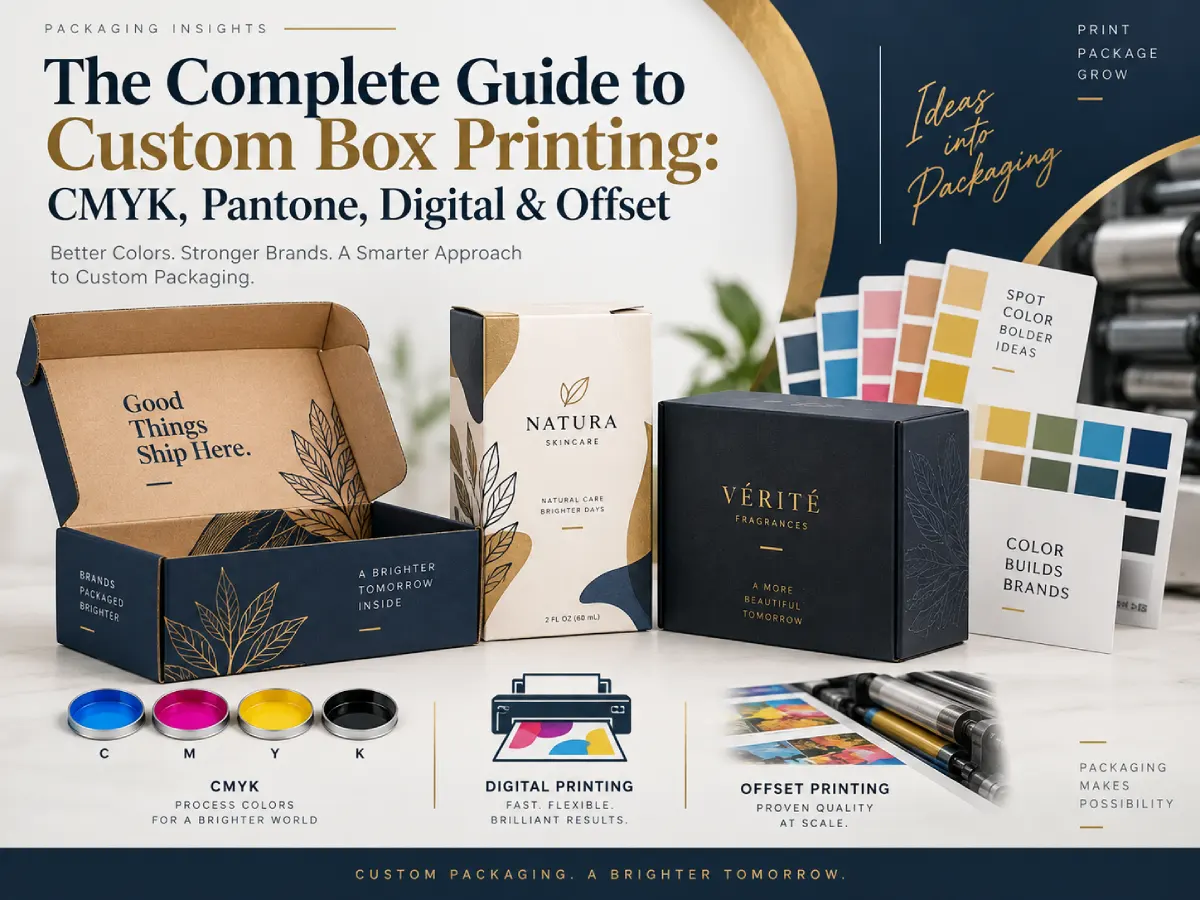
The Complete Guide to Custom Box Printing: CMYK, Pantone, Digital & Offset
Custom box printing adds your logo, colors, artwork, product details, patterns, and other branding to packaging made for your product. The difficult part is often deciding how that design should be printed. Terms like CMYK, Pantone, digital, and offset can sound similar, but they describe different parts of the printing process.
The simplest way to understand them is this: CMYK and Pantone deal mainly with how color is created or specified. Digital and offset describe how the design is transferred onto the packaging material.
That means you may use CMYK with digital printing, CMYK with offset printing, or CMYK together with Pantone spot colors on an offset job. The right setup depends on your artwork, brand colors, material, quantity, finish, and budget.
Custom Box Printing at a Glance
| TermWhat It MeansOften Best For | ||
| CMYK | Four-color process using cyan, magenta, yellow, and black | Photos, gradients, illustrations, and multicolor designs |
| Pantone | Standardized color system often used for specified spot colors | Important logo colors and solid brand colors |
| Digital Printing | Artwork is printed without conventional job-specific printing plates | Shorter runs, changing designs, test packaging, and multiple versions |
| Offset Printing | Ink transfers from a plate to a blanket and then to the printed surface | Larger stable runs, detailed print work, and controlled color workflows |
Pantone describes process printing as creating colors from a limited set of inks such as CMYK, while solid or spot printing uses individually formulated colors. Adobe also recommends CMYK mode when preparing documents for printing with process inks.
How Does Custom Box Printing Work?
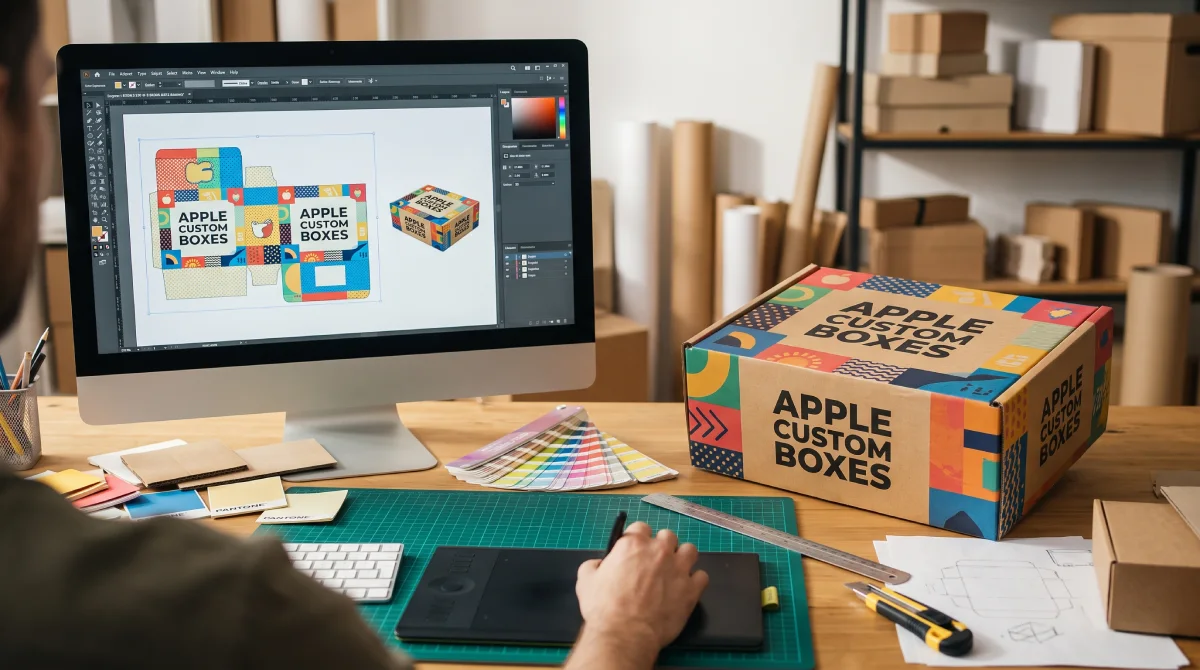
Most custom printed boxes begin with the box structure. Your packaging supplier needs to know the product dimensions, box style, material, quantity, and design requirements. A dieline can then show where the box will be cut, folded, and glued.
Your artwork is positioned on that dieline. The printing method and color setup are chosen before production. After artwork approval, the material is printed and converted into the final box structure. Finishes such as matte lamination, gloss, foil stamping, Spot UV, embossing, or debossing may also be added when suitable.
Apple Custom Boxes currently offers custom sizing, artwork support, digital and offset printing, CMYK and PMS options, dielines, samples, prototypes, and several finishing methods across its custom packaging boxes.
What Is CMYK Printing?
CMYK printing uses four process colors: cyan, magenta, yellow, and black. Small combinations of these inks are printed to create many other colors. The “K” represents the black or key component of the process.
CMYK is especially useful when packaging contains many colors instead of one or two solid shades.
When Should You Use CMYK for Custom Boxes?
CMYK is usually a strong choice when the design includes product photography, gradients, shadows, illustrations, textures, or several colors. A cosmetics box with a model photograph, for example, is far more suited to a full-color process than trying to build every shade from separate spot inks.
It also works well for colorful custom display boxes where graphics, product images, promotions, and branding may all appear on the same package.
What Are the Limits of CMYK?
CMYK cannot reproduce every color that a screen can show. Computer and phone screens create color using light, while printed packaging uses ink or toner on a physical surface. Bright RGB colors may therefore change when converted for print.
The material matters too. A color printed on bright white coated board can look different when the same artwork is printed on brown kraft or another uncoated stock.
For that reason, do not judge important packaging colors only from what you see on your monitor.
What Is Pantone Printing?
The Pantone Matching System, or PMS, gives designers and printers standardized color references. In packaging, Pantone is commonly associated with spot colors. Instead of building a solid brand shade from cyan, magenta, yellow, and black, a specified spot ink can be formulated for that color.
Pantone explains that solid or spot colors provide a more direct representation of a chosen color, while CMYK process printing builds colors using four inks in different ratios.
When Should You Use Pantone?
Pantone can make sense when a specific brand color matters more than having hundreds of colors in the design.
Imagine a premium skincare brand that uses one signature green across its logo, cartons, displays, and marketing materials. Specifying that important shade as a Pantone target gives the print supplier a clearer color reference than simply choosing a green by eye.
Pantone can also be useful for large areas of solid color and designs where strong color consistency is a priority.
Does Pantone Guarantee the Exact Same Look on Every Box?
No color specification can remove every production variable. Paper color, coating, texture, ink behavior, printing process, and surface finish can affect what the eye sees.
A Pantone shade printed on white coated paper may not look exactly the same on natural kraft. This is why color-critical packaging should be evaluated on a representative material or physical proof whenever possible.
CMYK vs. Pantone: Which Is Better for Box Printing?
Neither system is better for every packaging design. CMYK is generally more useful for complex full-color artwork. Pantone spot colors are useful when individual solid brand colors need tighter control.
| FactorCMYKPantone / Spot Color | ||
| Photos | Excellent fit | Not normally used alone |
| Gradients | Well suited | CMYK is normally more practical |
| Many colors | Efficient | Separate spot colors can add complexity |
| Specific logo color | Can approximate it | Useful when tighter color control is needed |
| Simple one-color artwork | Possible | Often worth considering |
| Brand color reference | Uses a CMYK build | Uses a standardized Pantone specification |
Some packaging uses both. A box can use CMYK for a product photograph while using a Pantone spot color for an important logo or brand element.
What Is Digital Printing for Packaging?
Digital printing sends artwork to a digital printing system without creating conventional job-specific printing plates. This removes a major setup step found in traditional offset production.
That makes digital printing useful when designs change often, quantities are smaller, several versions are required, or a business wants to test packaging before moving into a larger production run.
When Does Digital Printing Make Sense?
Digital printing can be a practical fit for product launches, short campaigns, seasonal packaging, samples, prototype runs, and brands with several SKUs.
For example, a new online clothing brand may want a smaller quantity of custom mailer boxes while testing its design. Digital production may provide more flexibility than setting up an offset job before the design and demand are stable.
Can Digital Printing Use Pantone Colors?
This needs a more careful answer than a simple yes or no. Many digital workflows reproduce a Pantone target by converting or simulating it with the color capabilities of the press rather than running a traditional premixed spot ink.
If an exact brand color is critical, ask how your Pantone specification will be produced and how the final color will be approved.
What Is Offset Printing?
Offset printing is an indirect printing process. The image is carried on a plate, transferred to a rubber blanket, and then transferred to the printing surface. OSHA describes this plate-to-blanket-to-substrate process as the basic configuration of offset lithography.
Offset requires more setup than digital printing, but that setup can make sense when the same artwork is being produced at greater scale.
When Does Offset Printing Make Sense?
Offset is often considered for larger or repeat runs, stable packaging designs, demanding color work, premium cartons, and jobs that need specific spot-color workflows.
It can be a strong option for high-end luxury rigid boxes, retail cartons, cosmetics packaging, and other projects where the design will be repeated across a sizable production order.
Digital vs. Offset Printing: Which Should You Choose?
The best method is not determined by quantity alone. A printer should also consider the box dimensions, material, number of designs, color requirements, print coverage, finishes, setup, and production requirements.
| FactorDigital PrintingOffset Printing | ||
| Printing plates | No conventional job-specific plates | Uses printing plates |
| Short runs | Often practical | Setup can make small runs less efficient |
| Large stable runs | Possible | Often worth comparing |
| Artwork changes | Flexible | Changes may require new setup or plates |
| Variable designs | Strong advantage | Less suited to constant artwork changes |
| Pantone spot ink | May be simulated depending on press | Can support dedicated spot-color workflows |
| Photos and full color | Yes | Yes |
Be careful with claims such as “digital is best under 500 boxes” or “offset is always cheaper above 1,000.” There is no single break-even quantity for every packaging project. A small box that fits many pieces on a sheet has different production economics from a large mailer or rigid box.
The safer approach is to quote the actual specifications and compare the suitable production methods.
CMYK, Pantone, Digital, and Offset Are Not Four Competing Options
This is one of the most important points in custom box printing.
You are usually making two decisions:
- How should the colors be specified and reproduced?
- Which printing process should produce the packaging?
That can lead to combinations such as:
- Digital + CMYK: useful for full-color artwork and flexible shorter runs.
- Offset + CMYK: useful for full-color artwork produced through an offset workflow.
- Offset + Pantone: useful for designs built around important solid spot colors.
- Offset + CMYK + Pantone: useful when a package contains full-color images plus one or more brand-critical spot colors.
Do not choose “Pantone instead of offset” or “digital instead of CMYK.” They are not direct alternatives.
How Packaging Material Changes Printed Color
The printing method is only part of the result. Your packaging material can change the appearance of the same design.
White Cardstock
A white base gives printed colors a neutral surface. It is often useful for colorful graphics, photos, beauty packaging, food cartons, and retail artwork.
Natural Kraft
Kraft has a brown base color. That base becomes part of the visual result unless the print process uses an appropriate underlying treatment or ink system. Colors may look warmer or more muted than they do on white board.
Corrugated Board
Corrugated packaging is widely used for shipping and mailers. Surface type and liner choice can affect detail and print appearance, so artwork should be planned around the actual board being used.
Rigid Packaging
Rigid boxes often use printed or specialty paper wrapped over a thick board structure. This creates more options for premium surfaces and finishing, but the final material and finish still need to be considered when approving colors.
Do Matte, Gloss, and Other Finishes Change the Print?
Yes. A finish can change how a printed color looks even when the ink values remain the same.
Glossy surfaces reflect more light and may make colors appear stronger. Matte or soft-touch finishes create a different visual and tactile effect. Spot UV can add gloss to selected areas. Foil stamping, embossing, and debossing add effects that are separate from normal CMYK printing.
This means you should approve the complete packaging specification—not only the artwork file.
How to Prepare Artwork for Custom Box Printing
Good printing starts before the press runs. A technically weak file can create problems even when the printing equipment is excellent.
1. Design on the Correct Dieline
The dieline maps the panels, cuts, folds, and glue areas of the package. Build the artwork around the final dieline instead of guessing where each panel will appear.
2. Prepare Colors for Print
Use the color specifications requested by the printer. Full-color process artwork is normally prepared in CMYK. Important spot colors should be clearly identified by their correct color reference.
3. Add Bleed
Artwork that reaches a cut edge normally needs to extend beyond the trim line. This extra printed area helps avoid unwanted unprinted edges after cutting. Use the exact bleed specification supplied by your packaging printer.
4. Keep Important Content Away From Cuts and Folds
Logos, legal text, QR codes, product names, and other important information should not sit too close to cutting or folding areas.
5. Use High-Quality Artwork
Vector files are ideal for logos and simple graphics because they can scale without becoming pixelated. Raster images should be supplied at a resolution suitable for their final printed size.
6. Check the Proof Carefully
Review spelling, dimensions, panel placement, barcode or QR placement, orientation, colors, and finishes before approving production.
Digital Proof vs. Physical Proof: Which Do You Need?
A digital proof is useful for checking layout, text, image placement, folds, and the general design. It should not always be treated as a perfect prediction of physical color.
A physical sample becomes more useful when material feel, color accuracy, finish, box structure, or presentation is critical.
Apple Custom Boxes currently provides a custom packaging sample pack that showcases selected stocks, CMYK and Pantone printing, box styles, and finishing options.
Common Custom Box Printing Mistakes
- Designing only in RGB and expecting the printed color to look identical to the screen.
- Using a CMYK approximation when a critical brand color needs tighter control.
- Paying for spot-color complexity when the design is mainly photos and gradients.
- Choosing digital or offset based only on a random quantity rule.
- Ignoring how kraft, coated board, or other materials change color appearance.
- Approving artwork without checking the dieline and fold positions.
- Using low-quality logo or product images.
- Placing important text too close to trim or fold areas.
- Choosing finishes without considering how they affect the final appearance.
- Skipping a representative physical proof when color is business-critical.
What Affects the Cost of Custom Box Printing?
There is no useful universal price for custom printed boxes because several specifications affect production.
Important cost factors can include:
- Box dimensions
- Material
- Box style and structure
- Order quantity
- Digital or offset production
- CMYK coverage
- Number of spot colors
- Printing on one or both sides
- Lamination and coatings
- Foil, Spot UV, embossing, or debossing
- Windows or inserts
- Sampling and proof requirements
- Shipping requirements
Apple Custom Boxes also states that pricing depends on specifications such as size, material, quantity, printing, finishing, inserts, and delivery requirements.
How to Choose the Best Printing Method for Your Boxes
Start with the artwork instead of starting with the printing machine.
If your design uses photographs, gradients, and many colors: begin by considering CMYK.
If one solid brand color must be closely controlled: discuss a Pantone spot color.
If you need a smaller or changing run: ask whether digital printing fits the project.
If you have a stable design and larger repeat production: compare offset pricing and production requirements.
If your design uses both photography and a critical logo color: ask whether a CMYK plus Pantone workflow makes sense.
If the box uses kraft or another colored material: evaluate the design on that material rather than approving it only on a white screen.
Custom Box Printing Examples
Example 1: Full-Color Cosmetics Carton
A skincare company wants product photography, gradients, several colors, and small text on its custom cosmetic boxes. CMYK would be a logical starting point. Digital or offset could then be selected based on quantity, material, finishing, and production requirements.
Example 2: Minimal Luxury Box
A jewelry brand uses a cream box with one specific dark green logo. If that green is an important part of the brand identity, a Pantone spot color may be worth discussing. Offset may then suit a stable production run, especially if other premium finishing is required.
Example 3: New E-commerce Brand
A startup wants several mailer designs for a new launch and expects the artwork to change. Digital printing may provide useful flexibility while the brand tests packaging concepts.
Example 4: High-Volume Retail Packaging
A brand has approved artwork that will remain stable across repeat production. Comparing offset production becomes more useful because setup can be spread across a larger quantity.
Questions to Ask Before Ordering Printed Boxes
- Will my artwork be printed in CMYK, Pantone, or both?
- Will you use digital or offset printing?
- If I provide a Pantone color, will it be printed as a spot ink or simulated?
- How will my chosen material affect the color?
- What file type and color settings should I provide?
- What bleed and safe-area specifications should I use?
- Can I see a proof or representative sample?
- Which finishes work with this material and print method?
- Would another printing method be more cost-effective for my quantity?
- What information do you need to quote the job accurately?
Get the Right Custom Box Printing Setup for Your Product
The best custom box printing method is the one that fits your actual packaging—not the one with the most impressive name.
Use CMYK when your artwork needs full-color flexibility. Consider Pantone when specific solid brand colors require closer control. Look at digital printing when flexibility and changing artwork matter. Compare offset when the design is stable, production grows, or the project needs an offset color workflow.
Then consider the material, finish, structure, and proof together. A great print file can still produce the wrong result if those choices are made separately.
Apple Custom Boxes offers custom sizing, CMYK and PMS color options, digital and offset printing, artwork support, prototypes, and finishing options for businesses across the USA. If you already know your dimensions, quantity, material, and design requirements, request a custom packaging quote and discuss the best production setup for your project.
D. FAQ Section
Frequently Asked Questions About Custom Box Printing
What is custom box printing?
Custom box printing is the process of adding logos, colors, artwork, text, product details, or other designs to packaging made for a specific product or brand. The design may be produced using digital, offset, or another suitable printing process.
Is CMYK or Pantone better for custom boxes?
CMYK is usually more suitable for photos, gradients, and artwork with many colors. Pantone spot colors can be useful when a specific solid brand color needs tighter control. Some packaging uses CMYK and Pantone together.
What is the difference between CMYK and Pantone?
CMYK creates colors by combining cyan, magenta, yellow, and black process inks. Pantone provides standardized color references and is commonly used to specify individual spot colors for brand-sensitive printing.
What is the difference between digital and offset printing?
Digital printing does not require conventional job-specific printing plates. Offset printing uses plates and transfers the image through a blanket before it reaches the printed surface. Digital offers strong flexibility, while offset can be useful for stable larger production runs and controlled spot-color workflows.
Can digital printing match Pantone colors?
Many digital presses can reproduce or simulate Pantone targets, but that does not always mean a premixed Pantone spot ink is being used. If a brand color is critical, ask how the color will be produced and approved.
Why do printed box colors look different from my computer screen?
Screens create color with light, while packaging is printed with physical inks or toner. The material, coating, printing process, lighting, and finish can also change how the final color appears.
Does kraft paper change printed colors?
Yes. Natural kraft has a brown base, so printed colors can look warmer or more muted than the same artwork on white board. Always plan important colors around the actual packaging material.
Is digital printing cheaper than offset printing?
Not in every case. Digital often reduces setup for smaller or changing jobs, while offset can become more economical for suitable larger runs. The true comparison depends on box size, material, quantity, artwork, colors, finishes, and production setup.
Should I request a physical sample before a large order?
A physical sample is useful when material, structure, finish, or color is important to the project. A digital proof is useful for checking layout but cannot always show exactly how physical packaging will look and feel.
How much does custom box printing cost?
Cost depends on the size, material, box style, quantity, printing method, colors, print coverage, finishes, inserts, and shipping requirements. An accurate quote should be based on the specifications of the actual packaging project.
About Apple Custom Boxes
Apple Custom Boxes is a premier USA custom packaging manufacturer delivering high-quality custom printed boxes, mailers, product packaging, and wholesale boxes with free design support and fast turnaround.